Payment Orchestration in Production: A GamesCashier Deep-Dive
From outside, payment orchestration looks like API routing: pick a processor, send the charge, handle the response. Inside, it's one of the harder distributed-systems problems in fintech — full of network partitions, eventual consistency, and money-on-the-line correctness requirements.
This is the engineering view of payment orchestration based on what we shipped for GamesCashier, a regulated payment platform handling multi-provider routing across traditional card rails, alternative payment methods, and crypto, with the audit trail and AML compliance the gaming and casino industry demands.
Key Takeaways
- The worst-case orchestration bug is double-charging a customer. The second-worst is failing to charge a customer who thinks they paid. Both come from missing idempotency keys at any layer of the chain.
- Reconciliation is the real product, not a back-office afterthought. Production-grade orchestration runs a daily pipeline that ingests settlement files, matches them to bookings, and surfaces mismatches as a queue with documented disposition workflows.
- Route per transaction, not per integration. Smart orchestration picks the rail by region, amount, customer risk score, processor health, and cost — not by a fixed "always Stripe" mapping.
- 3DS2 / SCA breaks naive checkout flows. The challenge can take any amount of time, complete with the customer never returning, or be exempted for the next transaction. State management for in-flight 3DS2 has to be deterministic and observable.
- Build-vs-buy break-even is roughly $5–10M annual processing volume. Below that, hosted orchestration (Spreedly, Primer) is cheaper. Above that, custom pays for itself in 12 months via processor cost optimization.
What payment orchestration actually buys you
A payment orchestrator sits between your application and the various payment processors. Its job:
- Routing — pick the right processor for each transaction based on cost, success rate, geographic coverage, regulatory fit
- Redundancy — if one processor fails, fall back to another without exposing the failure to the user
- Cost optimization — different processors have different fees; route to the cheapest one that meets the requirements
- Geographic coverage — different processors are strong in different regions; route accordingly
- Compliance routing — high-risk transactions might need processor A; standard transactions can go through processor B
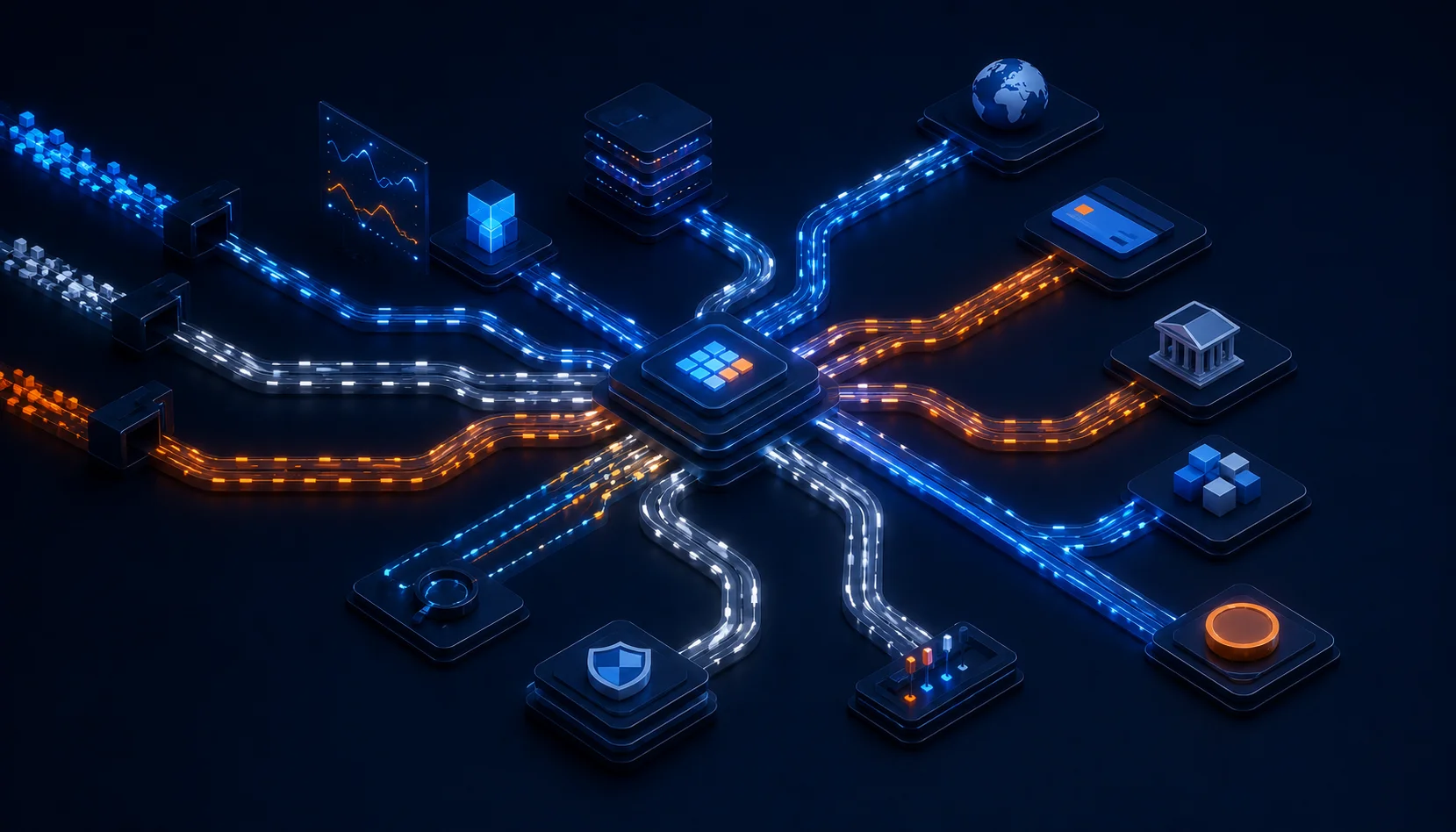
The architectural pattern: your application calls a single internal API; the orchestrator decides which downstream processor to actually use.
The complications start when you have to make this work correctly under realistic production conditions — network failures, retries, processor outages, regulatory holds, settlement reconciliation. That's where most teams underestimate the scope.
The non-negotiable: idempotency at every layer
In payment systems, the worst-case bug is double-charging a customer. The second-worst is failing to charge a customer who thinks they paid. Both come from missing or broken idempotency.
The pattern that works:
Client generates an idempotency key. A UUID that uniquely identifies this payment intent. Propagated through every layer of the chain.
const idempotencyKey = crypto.randomUUID();
await api.charges.create({
  amount: 1000,
  currency: 'usd',
  source: 'tok_visa',
  // ...
}, {
  idempotencyKey,
});
Server-side idempotency cache. When a request comes in with an idempotency key, check whether you've seen this key before. If yes, return the cached result (whether success or failure). If no, process the request and cache the result.
Idempotency propagates downstream. When your service calls the processor's API, include your idempotency key (or derive a deterministic one from yours). Both Stripe and Adyen support idempotency keys natively.
Replays are explicit operations. If the operations team needs to retry a failed transaction, that's a logged, audited operation — not an implicit retry that could create duplicates.
In production, this pattern catches things you don't expect. Network drops at strange times. Processor responses that don't quite confirm. Browser tabs that get refreshed mid-checkout. The idempotency layer absorbs all of them without producing duplicates or losses.
Reconciliation is the real product
Payment orchestration looks like "charge the card." Production payment orchestration is "match this morning's settlement file from the processor against last week's bookings against last quarter's invoices."
The reconciliation problem:
- Processors send settlement files (often daily) reporting which transactions actually cleared
- Your application's view of "what happened" is the request/response history
- Sometimes these match. Sometimes they don't. The mismatches are where money lives or dies.
Common mismatch causes:
- Transactions that succeeded in your view but failed in settlement. A chargeback, a delayed decline, a regulatory hold.
- Transactions that failed in your view but succeeded in settlement. Network drop after the processor charged but before you got the success response. Now there's money you didn't track.
- Currency conversion timing differences. Settled at a different rate than booked.
- Fees deducted in settlement that weren't in your application's calculation.
- Refunds processed externally (via the processor's UI, by a support agent) that your application doesn't know about.
The production-grade pattern: a reconciliation pipeline that runs daily, ingests settlement files, matches transactions, surfaces mismatches as exception cases for human review with documented disposition workflows.
Our reconciliation pipeline for GamesCashier handles ~30 different types of mismatches with auto-resolution patterns for common cases and exception workflows for edge cases. The exception queue is itself a system-health metric — when exceptions pile up, that's an early signal of an upstream issue.
Multi-processor routing patterns
The orchestrator decides which processor to use. The decision logic:
Per-transaction routing rules.
if region in (US, CA):
    prefer Stripe (high success rate, low fee)
elif region in (EU, UK):
    prefer Adyen (better SCA handling)
elif region in (BR, MX, ...):
    prefer regional processor X (local payment methods)

if amount > $10,000:
    require step-up authentication

if customer_risk_score > threshold:
    require 3DS2 challenge

if processor is in degraded state:
    fall back to next-best processor
Health-aware routing. Continuously monitor processor success rates. When a processor degrades, automatically reduce its weighting. Catches outages before they spike your customer support volume.
Cost-aware routing. Different processors have different fee structures. Route low-margin transactions to the cheaper processor; high-value transactions to the more reliable one.
Compliance-aware routing. Some transactions have regulatory constraints (gaming/casino in certain jurisdictions, high-risk merchant categories, etc.). The orchestrator routes those through processors that have the appropriate licenses and risk appetite.
3DS2 and Strong Customer Authentication
For regulated payment flows, especially in Europe (PSD2/SCA), payment authentication isn't a simple "charge the card" anymore. The 3DS2 protocol adds a real-time challenge step that can:
- Redirect the user to a bank-controlled authentication page
- Take an arbitrary amount of time to complete
- Be successfully completed but the customer never returns to your checkout
- Be challenged for one transaction but exempted for the next
The orchestrator has to handle all of this. State management for in-flight 3DS2 flows. Retry logic for transactions where the challenge was abandoned. UI state that doesn't confuse users who are getting redirected to their bank's site.
The frictionless flow is "card details → success." The frictional flow is "card details → redirect to bank → challenge response → maybe success." Both flows have to be reliable; both have to be observable; both have to produce the same audit record.
Crypto rails alongside fiat
Increasing number of fintech products need to support both traditional card rails and crypto/stablecoin payments. The architectural pattern:
The orchestrator presents a unified payment API to the application. Behind it, traditional rails (cards, ACH, RTP) and crypto rails (USDC, USDT, on-chain settlement) are separate downstream implementations.
The compliance constraints differ:
- Fiat rails — PCI-DSS, KYC, AML transaction monitoring
- Crypto rails — AML screening on each deposit, sanctions screening (OFAC), Travel Rule compliance for transactions over $3K, source-of-funds analysis for high-value transactions
The patterns we ship for crypto:
- Stablecoin payments routed through KYC'd on-ramp providers (Wyre, MoonPay, Coinbase Commerce, etc.)
- On-chain settlement with AML pre-screening of destination addresses
- Off-ramps to fiat with the same compliance surface as fiat-to-fiat
- Wallet-as-a-service patterns for products that need custody — not custody we operate, but custody from a regulated provider
- Audit trail that satisfies both fiat and crypto compliance regimes from the same data
GamesCashier specifically has stablecoin payment flows running alongside traditional card rails in the same orchestrator, with AML compliance evaluated at the same risk-scoring layer regardless of which rail a transaction came through. That unified compliance posture is what makes it work for regulated gaming customers.
Fraud prevention layered into the orchestrator
The orchestrator is the right architectural layer for fraud signals:
- Device fingerprinting captured at checkout
- Behavioral signals (velocity, geographic anomalies, transaction patterns)
- Vendor-side risk signals (the processor's own risk score)
- Internal blocklists for known-bad actors, addresses, patterns
- AML/sanctions screening for higher-value transactions
Unified scoring across signals produces a single risk decision per transaction. The orchestrator routes based on that score — frictionless flow for low-risk, step-up authentication for medium, decline or manual review for high.
For GamesCashier the fraud signals also feed back into the orchestrator's processor routing — accounts that show suspicious patterns get routed through processors with stricter risk controls.
Observability is the unsung requirement
Payment orchestration that works in normal conditions but fails in incidents is worse than no orchestration. The observability stack we run:
- Per-transaction tracing through every layer of the orchestrator
- Success/failure metrics per processor with rolling windows
- Latency distributions per processor (cold-tail latency is itself a signal)
- Exception queues with SLAs on resolution
- Settlement reconciliation dashboards showing the lag between booking and settlement
- Audit log for every state transition
Operations teams should be able to answer "what happened to transaction X" in under a minute, regardless of which processor it went through.
Cost considerations
Payment orchestration cost shows up in:
- Engineering build — typically 12-24 weeks for an initial orchestrator covering 2-3 processors. Longer for crypto integration.
- Operational cost — reconciliation, exception handling, fraud review tooling. Some of this is built-in tooling; some is humans-in-loop.
- Per-transaction cost — the orchestrator itself is operationally cheap; the value compounds via processor cost optimization (typically 5-15% savings on processing fees through smart routing once at scale).
The break-even on building custom orchestration vs using a hosted orchestrator product (Spreedly, Primer, etc.) is roughly $5-10M annual processing volume. Below that, hosted is cheaper. Above that, custom orchestration pays for itself within 12 months through fee optimization, plus the compliance and customization control.
If you're scoping a custom payment orchestration build, modernizing a payment system that's accumulated complexity, or evaluating whether to build vs buy, we'd be glad to talk. See our fintech software development services, the PCI-DSS architecture guide for the compliance side of payment-handling, and our piece on MCP in fintech AI for how AI fits into the orchestration layer.
.png)